
Riparian Vegetation
Riparian vegetation restoration for biodiversity enhancement.
A Lowland Drainage Basin Under Climate Pressure
The drainage basin of the Lagoon of Venice spans over 100,000 hectares with a river and canal network exceeding 2,350 km under the jurisdiction of the Acque Risorgive Reclamation Consortium (CBAR). Managing and maintaining such an intricate hydrological system is a formidable task increasingly complicated by climate change.
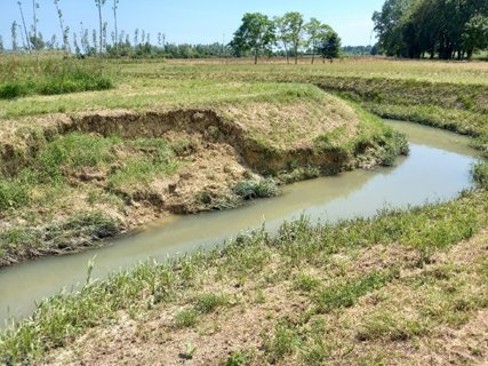
More intense rainfall events, prolonged droughts, and rapid water-level drawdowns accelerate soil instability, causing recurrent riverbank landslides. Conventional mechanical interventions—such as complete herbaceous clearance and channel dredging—strip protective root systems, creating a vicious cycle of soil erosion, channel siltation, and ecological degradation.
As part of the NATALIE project, nature-based river restoration and selective maintenance techniques are implemented along the Pianton and Vernise rivers, proving that bio-engineering alternatives can stabilize slopes while reviving vital riparian corridors.
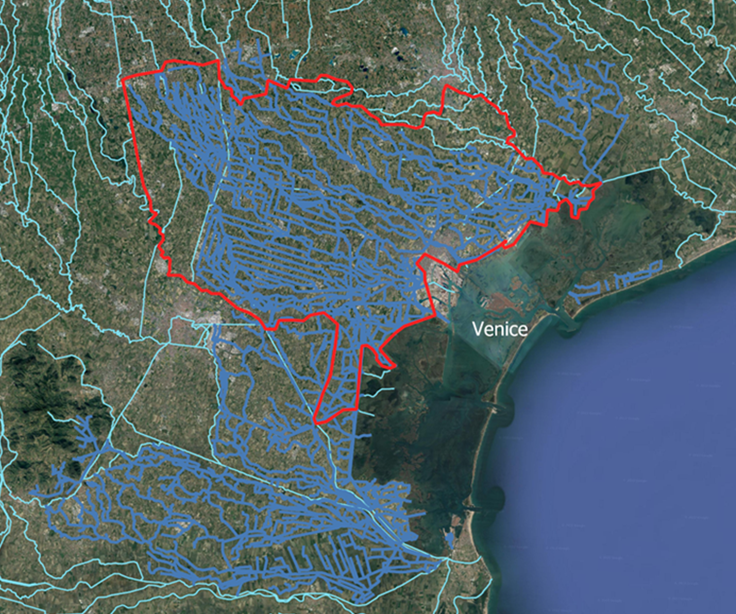
Pianton River bank subject to instability, erosion, and vegetation reshaping under Case Study 8.
Riverbank Landslides
Soil saturation, pore pressure fluctuations, and steep artificial slopes triggering structural bank collapse into the canal.
Biodiversity Loss
Frequent total mowing eliminating nesting cover, pollinators, and aquatic macroinvertebrate habitats across the agricultural plain.
Fluvial Flood Surcharge
Sediment deposition and compromised channel profiles reducing discharge capacity during high-intensity storm events.
Nature-Based Riverbank Restoration (NBS1 & NBS2)
To break the cycle of repeated erosion and costly dredging, two synergistic nature-based solutions are tested and monitored in the Venice catchment:
NBS1 (Selective Herbaceous Maintenance): Instead of mowing the entire bank down to bare earth, an uncut buffer strip (1.0–1.5 meters wide) is preserved at the water's edge. This natural grass-sedge fringe armors the toe of the slope against hydraulic shear stress and filters agricultural runoff.
NBS2 (Bank Slope Reduction & Vegetative Bio-Engineering): On vulnerable stretches subject to sliding, the bank geometry is reprofiled to a gentler slope (reducing bank angles from 1:1 to 1:2 or 1:3). The reshaped bank is stabilized using bio-engineering methods, transplanting native willow, alder, dogwood shrubs, and hygrophilous herbaceous species whose deep root networks bind the soil.
Reprofiled slope with selective vegetation: Uncut aquatic buffer strip → Native shrub stabilization → Upland grass transition.
Soil Stabilization
Root mechanical reinforcement increases soil shear strength, preventing bank slides during rapid drawdown events.
Water Attenuation
Reshaped bank geometry and vegetated roughness dissipate hydraulic flow velocities, mitigating downstream peak stages.
Biodiversity Conservation
Re-establishes unbroken ecological corridors connecting regional Natura 2000 habitats across the Venice agricultural plain.
Performance Assessment
Safety factor increase against bank sliding through root bio-engineering and slope reprofiling.
Helophyte and hydrophyte riparian vegetation cover under NBS compared to 13.3% in complete cut controls.
Protected avian species sustained across surveyed Pianton river reaches.
Continuous water level telemetry (AR042–AR045) and meteorological monitoring grid.
The performance of the Venice NBS interventions is monitored continuously across hydraulic and ecological dimensions. Level sensors deployed at two key cross-sections on the Pianton River (AR044 upstream, AR045 downstream) and Vernise River (AR042 upstream, AR043 downstream) track flow regimes and stage fluctuations, corroborated by rainfall and wind telemetry from the Mogliano Veneto meteorological station.
Ecological indicators include multi-season transect surveys of bird abundance, vegetation cover classification along reshaped banks, and tracking the spatial impact of the invasive coypu (nutria). The data validates that reprofiled, vegetated slopes sustain richer biodiverse communities while actively mitigating bank sliding and erosion risks.
Interactive Technical Dashboard Available
Access real-time water levels (AR042–AR045), Mogliano Veneto meteorological timeseries, HEC-RAS 1D flood simulation plots, and multi-criteria radar impact indicators.
Making the Economic Case for Nature
Conventional emergency maintenance following bank collapse requires mechanical re-excavation, heavy rip-rap stone armoring, and frequent channel dredging, costing up to €180 per linear meter.
In contrast, reprofiled and vegetated banks become self-stabilizing over time. Cost-benefit analysis reveals that upfront reprofiling investments are offset within a decade through a 55%–65% reduction in recurring mechanical maintenance, while simultaneously intercepting agricultural sediment loads that would otherwise silt up the UNESCO Venice Lagoon.
Lower recurring earthwork and dredging expenses over a 20-year cycle.
Retained soils prevented from entering Venice Lagoon navigational channels.
Net positive economic returns under severe climate projection pathways.
From Pilot Reaches to Lagoon-Wide Strategy
The experience on the Pianton and Vernise pilot reaches provides a viable roadmap for CBAR and water authorities across the greater 100,000-hectare Venice Lagoon drainage network.
Mainstreaming bio-engineering across the 2,350 km watercourse network addresses three critical pillars: technical operational standards, collaborative regional governance, and agricultural incentive alignment under European Common Agricultural Policy (CAP) eco-schemes.
Standardizing slope reprofiling geometries (1:2 to 1:3) and selective mowing equipment manuals for consortium operators.
Establishing shared maintenance agreements coordinating CBAR reclamation consortium, ARPAV, and municipal flood authorities.
Incentivizing farmers to maintain vegetated river buffer strips through European Common Agricultural Policy (CAP) eco-schemes.
Links to Go Deeper
Performance Roadmap
Practical guidance for designing and implementing an NBS performance assessment tailored to your own watershed.
Venice Case Study Report
Detailed CBAR bio-engineering methodology, bank slope reprofiling specifications, and ecological monitoring data.
Technical Study & Dashboard
Venice sensor feeds (AR042–AR045), water level telemetry, HEC-RAS flood simulations, and radar impact scores.