
Drains removal
Agricultural drain removal for wetland restoration and water retention.
A Wetland Under Pressure
Maspalomas Pondis one of Gran Canaria's most valuable coastal ecosystems. Located in the island's main tourism hub, the wetland faces growing pressure from urban runoff, water pollution and the impacts of climate change. As rainfall becomes more irregular and intense, improving the way stormwater is managed has become critical not only for protecting biodiversity, but also for safeguarding environmental quality.
To address these challenges, the municipality and the island government (Cabildo) are introducing Sustainable Urban Drainage Systems (SUDS) across the catchment as part of the NATALIE Project. These nature-based solutions (NBS) capture, filter and retain polluted rainwater before it reaches the pond, helping to improve water quality while restoring natural hydrological processes that have been progressively lost through urbanisation.
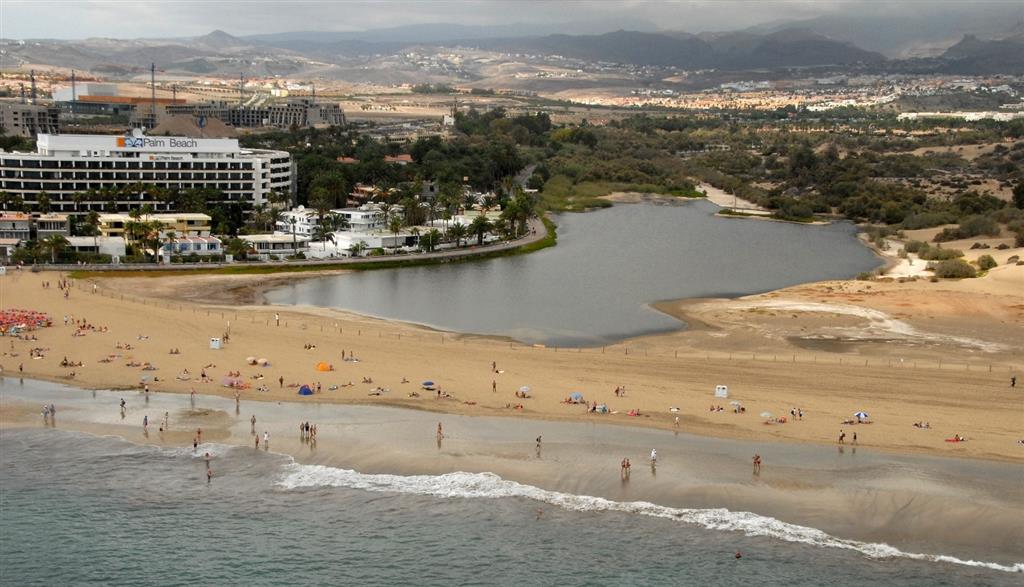
Maspalomas Pond (La Charca), a sensitive coastal wetland adjacent to major tourist developments.
Pollution Inflows
Runoff and Combined Sewer Overflows (CSOs) discharging directly toward the coastal pond during downpours.
Urban Density
High soil sealing in Oceanía Street and surrounding hotels preventing natural water infiltration.
Biodiversity Vulnerability
Eutrophication and habitat degradation threatening local avian fauna and aquatic plant species.
Nature as Infrastructure
Unlike conventional drainage systems that move water away as quickly as possible, SUDS are designed to work with natural processes. By slowing runoff, increasing infiltration, and filtering pollutants, they reduce pressure on drainage networks while creating healthier conditions for ecosystems.
In Maspalomas, the intervention is supported by a network of monitoring sensors and advanced hydrological models that track water quality and stormwater dynamics. This evidence base helps local authorities understand how the system performs over time and identify opportunities for future expansion.
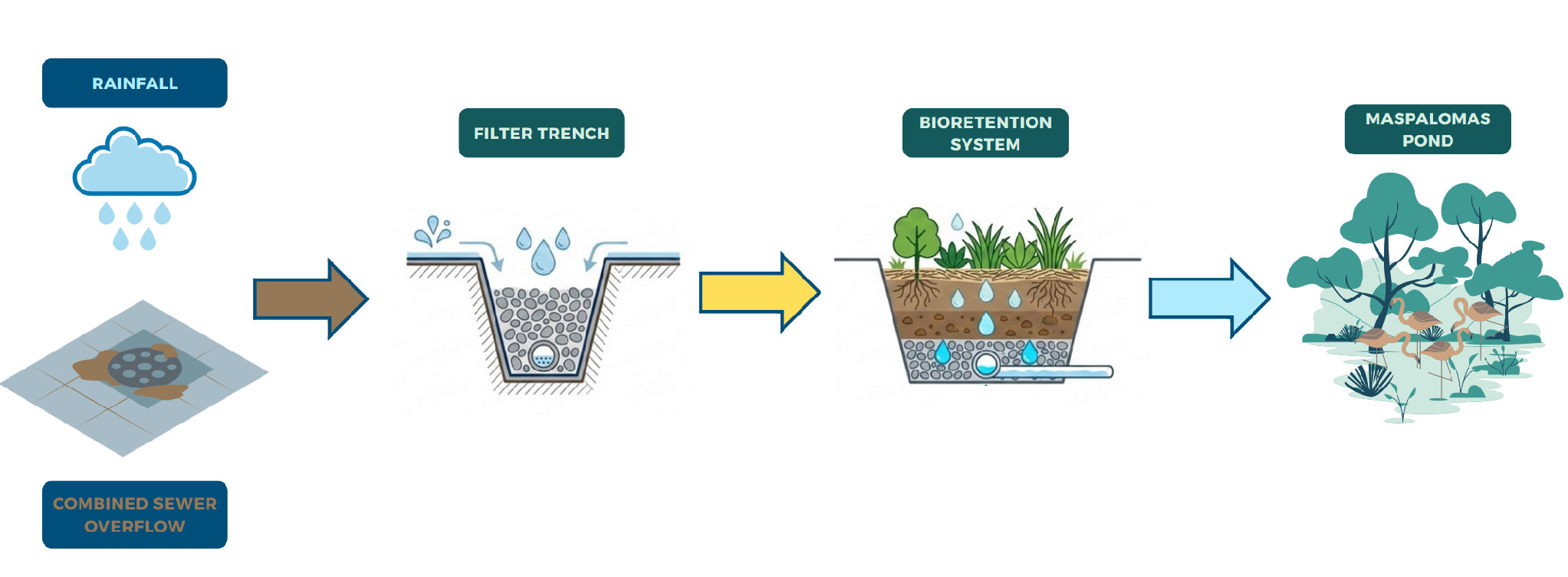
Rainfall & Combined Sewer Overflow (CSO) → Filter Trench → Bioretention System → Purified Discharge to Maspalomas Pond.
Performance Assessment
Retains stormwater events exceeding a 5-year return period, protecting lower Oceanía Street.
Elimination rates for Total Suspended Solids (TSS), Nitrogen, and Phosphorus.
BOD/m²/day operating range, providing optimal biological purification.
Direct reduction in emergency cleaning and maintenance costs following overflow events.
The SUDS treats a mixture of water from Combined Sewer Overflows (CSOs) and surface runoff from Oceanía Street. Monitoring is used to assess the total suspended solids (TSS), organic matter (BOD and COD), nutrients, and heavy metals removed by the bioretention system. The information generated provides a valuable knowledge base for the design, sizing, and optimization of similar future interventions.
Interactive Technical Dashboard Available
View high-resolution hydrological modeling charts, meteorological timeseries data, and multi-criteria performance indicator evaluations.
Making the Economic Case for Nature
The analysis carried out in the NATALIE project suggests that investing in NBS can deliver measurable economic returns alongside environmental benefits.
Using a 30-year assessment period, the cost-benefit analysis found that benefits outweigh costs under both moderate and high climate change scenarios. Under a moderate scenario, every euro invested is expected to generate €1.14 in benefits. Under a more severe climate scenario, this increases to €1.42, with the initial investment recovered after approximately 14 years.
Benefits exceed costs across all climate projection pathways.
Full initial investment recovery within the 30-year operational timeframe.
Driven by tourism appeal, biodiversity, recreation, and green jobs.
From Pilot Project to Island-Wide Strategy
The experience in Maspalomas points to a wider opportunity for Gran Canaria. While the current intervention focuses on a specific catchment, its lessons are already informing discussions about how NBS can be mainstreamed across the island.
The Maspalomas project addresses three critical barriers to NbS mainstreaming: knowledge, governance, and financing.
Building institutional confidence and standardizing design parameters for future interventions across arid climates.
Establishing multi-level administrative protocols bridging the municipal council, Cabildo, and Canary Islands government.
Channeling private tourism profits into green infrastructure via the Canary Islands Reserve for Investments (RIC) fiscal framework.
Links to Go Deeper
Performance Roadmap
Practical guidance for designing and implementing an NBS performance assessment tailored to your own watershed.
Full Gran Canaria Report
Detailed prefeasibility study, cost-benefit calculations, and financing structure for Maspalomas.
Technical Study & Dashboard
Gran Canaria sensor feeds, water level telemetry, runoff simulations, and radar impact scores.